Pedestrian Door vs. Side Door: Which Walk-In Option Is Right for Your Garage?
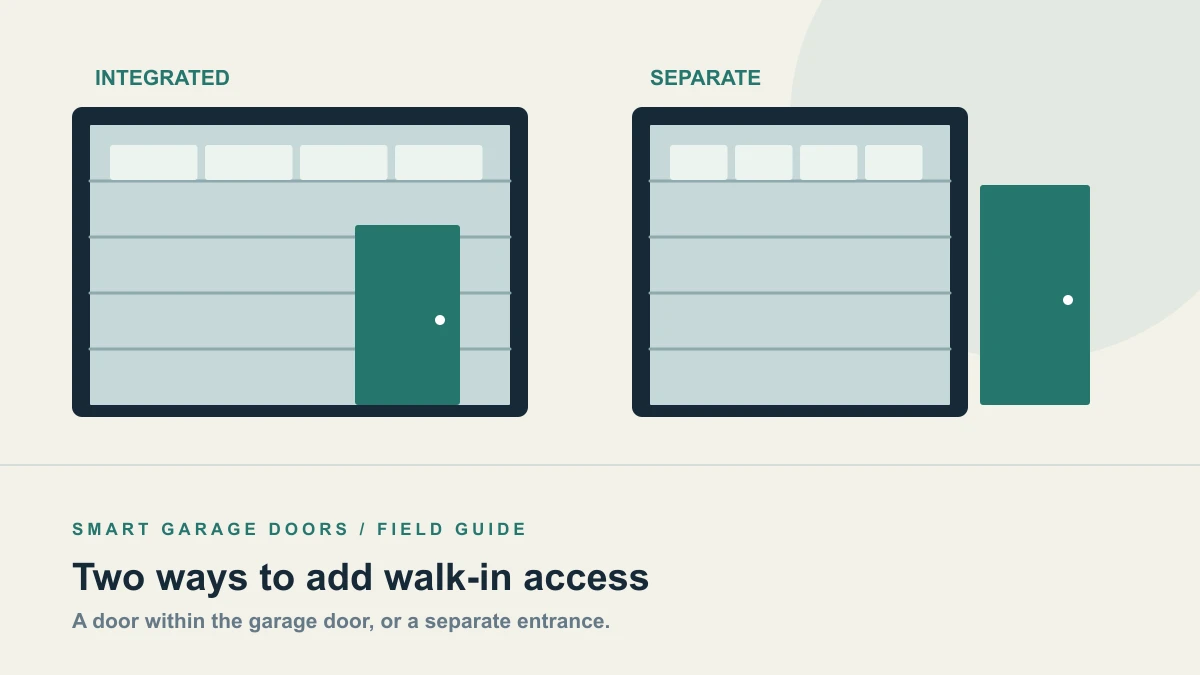
Want to walk into your garage without opening the big door? Compare a built-in pedestrian (wicket) door, a separate side man door, and a smarter opener — cost drivers, pros, cons, and who should pick which.
The request we hear is almost always the same: "I want to get into my garage without opening the whole door." There are three real ways to solve that, and they range from a few hundred dollars to a custom-built door. Most people only hear about one of them. This guide puts all three side by side so you can pick the one that actually fits your garage — not the one that happens to be the most expensive.
The three options
1. A pedestrian door built into the garage door. Also called a wicket door, man door, or pass door — a person-sized door framed into one of the lower panels of the garage door itself. You open the small door to walk through; the full door still rolls up for the car. Full details on our pedestrian garage door page.
2. A separate side door in the garage wall. A standard exterior entry door cut into a side or rear wall of the garage. This is what most detached garages already have.
3. A better opener. Not a door at all — a modern opener with a keypad, phone app, and quiet belt drive. It doesn't give you a walk-in door, but for a lot of people the real frustration is the opener, not the opening.
Start with one question: do you have a wall?
This is the whole decision for most homes. Look at the garage from the outside. Is there an exterior wall — side or rear — with room for a 36-inch door, that isn't blocked by a neighbor's property line, a fence, or the house itself?
- Yes, there's a usable wall: a separate side door is almost always the cheaper, simpler answer. It's a standard entry door, it doesn't touch the garage door system, and any contractor can install it.
- No usable wall: attached garages in row houses, zero-lot-line builds, garages where the big door takes up the entire front and the other three walls are interior or shared. Here a pedestrian door built into the garage door is often the *only* way to get a walk-in entrance — and that's exactly who it's designed for.
If you're in the second group, skip the agonizing: the pedestrian door isn't an upgrade you're choosing over something cheaper, it's the solution to a layout problem.
Pedestrian door: pros and cons
Pros - Works when there's no wall to cut into - Walk in and out without cycling the opener — fewer spring and opener cycles, less wear - A way in or out during a power outage without pulling the manual release - The full door stays closed and sealed on quick trips, which matters on an insulated or heated garage - Lockable, weatherstripped, and built with real exterior-door hardware
Cons - It's built into a custom-manufactured, reinforced panel, so it costs meaningfully more than a standard door — you're buying a second complete door plus heavier springs and track - Built to order, so there's a manufacturing lead time before installation - There's a raised threshold at the bottom (a step of a few inches), so it's not a flush, no-step entry - Generally has to be built into a new door rather than retrofitted into one you already own
Separate side door: pros and cons
Pros - Usually the least expensive way to get a walk-in entrance - Flush, full-height, no step-over threshold — better for wheelchairs, hand trucks, and rolling toolboxes - Doesn't touch the garage door system at all; no custom panel, no heavier springs - Can be done by a general contractor alongside other work
Cons - Requires a wall you can cut into, with room for a header and framing - May need a permit and exterior finishing (siding, brick, trim) - Puts an entrance on the side or back of the house, which may be less convenient than the driveway side - Doesn't help if the goal is specifically driveway-side access
A better opener: the option most people skip
Be honest about the complaint. If it's "I hate waiting for the door every time I grab something," a modern opener changes the experience more than people expect: a keypad outside so you never need the remote, a phone app to open it from the car before you pull in, a belt drive that's quiet enough for a bedroom above the garage, and battery backup for outages.
It doesn't give you a walk-through door. But it costs a fraction of either door option, and for a detached garage or a house where the garage door is the natural entrance anyway, it solves the daily annoyance. Our post on repairing vs. replacing a garage door opener covers when an upgrade makes sense.
What drives the cost of each
We don't publish a flat price for pedestrian doors because every one is built to a specific opening, but here's what you're paying for so the quote makes sense.
Pedestrian door: a custom-manufactured section with the opening engineered in; structural reinforcement around the cutout; a complete second door (jamb, threshold, hinges, lockset, closer); heavier springs and track to carry the extra panel weight; an interlock so the opener can't run while the walk-through door is open; and a longer install where two doors get hung and tested. If the main door is being replaced anyway, the pedestrian door is an add-on to that project. If the main door is fine, the cost includes a new main door, because the panel has to be built in.
Side door: the door unit itself, framing and a header, cutting the opening, exterior finishing, and possibly a permit. The variable is the wall — cutting into brick or stucco costs more than cutting into a framed, sided wall.
Opener: a fixed, well-known range. See our garage door repair cost guide for published opener pricing.
Who should pick which
- Attached garage, no usable side wall, want driveway-side walk-in access: pedestrian door. It's the only option that solves this.
- Detached or side-accessible garage, want the cheapest walk-in entrance: separate side door.
- Need flush, no-step access for a wheelchair, scooter, or rolling equipment: separate side door. The pedestrian door's threshold rules it out.
- The real problem is the opener — slow, loud, no keypad, dies in outages: opener upgrade first. See whether the door complaint goes away.
- Commercial building, staff crossing a dock or bay opening all shift: pedestrian (pass) door in the main door, with commercial closer and interlock. This is an operations decision, not a convenience one — every avoided cycle is spring and opener life.
- Want a pet door: none of these, strictly — but a pedestrian door with a pet flap installed in it is a common and secure version of the idea.
How we quote it
Send us photos of the garage from the outside — the door, both side walls, and the back if you can see it — and tell us what you're trying to do. We'll tell you which of the three options fits, and we'll price the pedestrian door with the alternatives next to it so you're comparing real numbers. Plenty of people look at all three and pick the pedestrian door because it's the only thing that works for their layout. Plenty pick the side door and save money. Either way, you should be choosing, not guessing.
Not sure which one fits your garage? Text us photos of the door and side walls, or call (914) 557-6816. We'll tell you which option works and price them side by side — no pressure either way. Full details on our pedestrian garage door page.
Frequently Asked Questions
Common questions about this topic.
If your garage has no usable side wall for a separate door — common with attached garages, row houses, and zero-lot-line builds — a pedestrian door is usually the only way to get walk-in access, and it's worth it. If you do have a wall, a separate side door is typically cheaper and gives a flush, no-step entry.
Need Professional Help?
While these tips are helpful, some garage door issues require professional expertise. Smart Garage Doors offers expert repair services throughout NY, NJ & CT.