Spring Cycle Ratings Explained: Why Your Busiest Bay Door Keeps Eating Springs
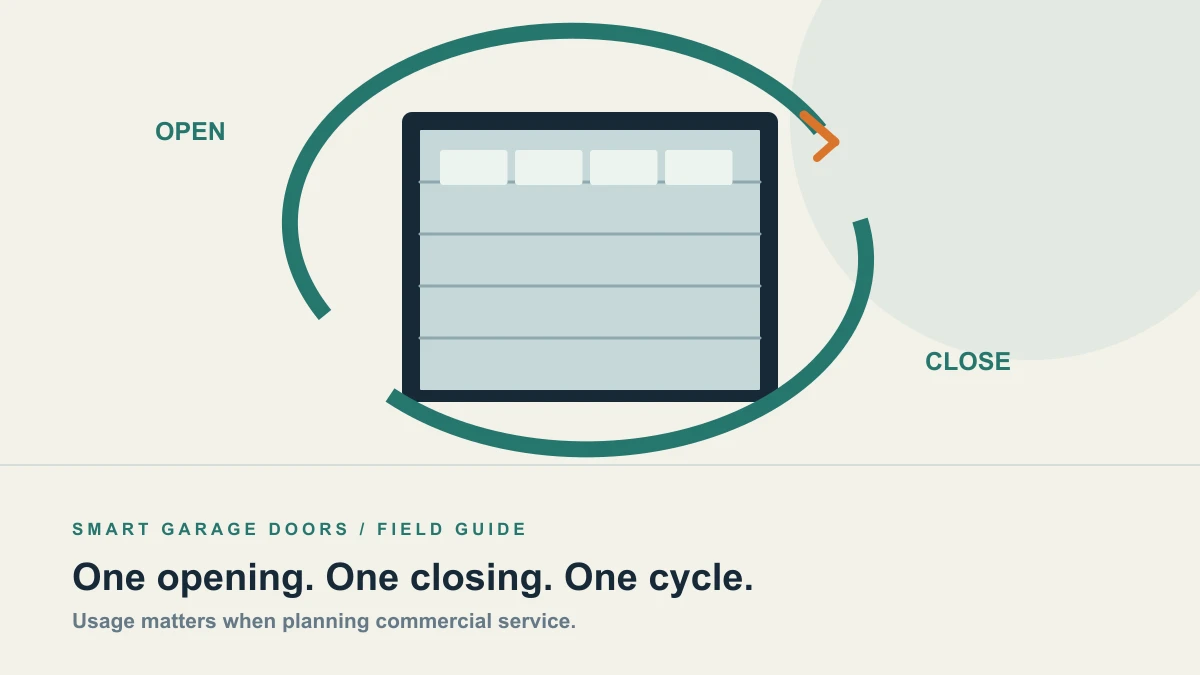
Standard torsion springs are rated ~10,000 cycles. A busy commercial bay burns that in a year or two. How high-cycle spring upgrades work and when each rating makes sense.
If the same dock door has snapped a spring twice in three years, nothing is wrong with the installs. The math is wrong. The door was fitted with springs rated for a residential duty cycle and then asked to do commercial work, and it's failing exactly on schedule.
Torsion springs counterbalance the door's weight so a 600-pound steel curtain can be lifted by a fractional-horsepower operator. They're also a consumable with a published service life, measured in cycles. Understanding cycle ratings turns spring failures from random emergencies into a line item you can schedule.
Here's how the ratings work, the cycles-per-day math, and when a 25k, 50k, or 100k upgrade actually pays for itself.
What a Cycle Rating Actually Means
One cycle is one full open and one full close. A spring's cycle rating is the number of cycles it's engineered to survive before metal fatigue ends its useful life — and the industry-standard spring that ships on most doors is rated around 10,000 cycles.
That number wasn't chosen for commercial duty. On a residential door cycling 3–4 times a day, 10,000 cycles is seven to ten years of service. The problem is that the same standard spring gets installed on commercial doors by default — by builders, low-bid contractors, and anyone replacing a broken spring like-for-like without asking how hard the door works.
Higher-rated springs aren't a different technology. They're the same torsion spring made from heavier-gauge wire with a larger diameter, which spreads the flex across more steel and slows the fatigue. More steel costs more, lasts proportionally longer, and mounts in the same place.
The Cycles-Per-Day Math
Take your door's realistic daily cycle count and divide it into the rating. The arithmetic is blunt:
- 5 cycles/day (light-duty drive-in door): a 10k spring lasts ~7–8 years
- 15 cycles/day (moderate dock door): a 10k spring lasts ~2.5 years
- 25 cycles/day (busy bay): a 10k spring lasts ~15 months
- 40 cycles/day (cross-dock or parking gate duty): a 10k spring is done in under a year
That last row is why a busy facility on standard springs lives in a permanent spring-replacement loop — and why each failure arrives as an emergency.
Run the same duty against high-cycle ratings and the picture changes:
- 25,000 cycles at 25 cycles/day: roughly 3 years
- 50,000 cycles at 25 cycles/day: roughly 5.5 years
- 100,000 cycles at 40 cycles/day: roughly 7 years on the hardest-working door in the building
Estimating cycles per day is easy: count truck appointments, shift changes, and forklift trips through the door for one normal day. Most managers underestimate by half.
When Each Rating Makes Sense
There's no virtue in over-buying springs for a door that barely moves, and no economy in under-buying for one that never stops. A reasonable decision framework:
- 10,000 cycles — fine for genuinely low-duty doors: a fire-exit bay, a seasonal-use door, anything under ~5 cycles a day. If it'll take eight years to wear out the cheap spring, buy the cheap spring.
- 25,000 cycles — the sensible default for working commercial doors in the 10–20 cycles/day range. Modest cost premium, and it moves spring replacement from a two-year headache to a five-plus-year scheduled event.
- 50,000 cycles — for busy dock doors at 20–35 cycles/day, or for facilities where door downtime is expensive enough that fewer replacement events is worth paying for on its own.
- 100,000 cycles — for the hardest-duty doors: high-volume cross-docks, 24-hour operations, and high-cycle applications like apartment-building parking gates that can cycle hundreds of times a day. On those doors this is the only rating that doesn't put you on a first-name basis with your spring vendor.
The labor to swap springs is roughly the same regardless of rating — the truck roll, the takedown, the winding. When you're paying for the visit anyway, upgrading the steel is usually the cheapest part of the job, which is why replacing a failed 10k spring with another 10k spring on a busy door is almost always the wrong call.
Signs a Spring Is Near End of Life
Springs rarely fail without warning if someone is looking. The tells, roughly in order of appearance:
- The door feels heavy. Pull the manual release and lift the door by hand — a properly balanced door lifts with modest effort and stays put at waist height. A door that wants to slam down has springs that are no longer carrying the weight.
- The operator strains. Slower opens, groaning, hesitation at the start of travel, or thermal cutouts mid-shift. The operator is doing the spring's job, and operators burned out by bad springs are a common — and avoidable — secondary repair.
- Visible stretch, rust, or gaps. A healthy torsion spring is a tight, uniform coil. Gapping between coils, corrosion, or any visible separation means fatigue is advanced. A full gap means it's already broken.
- It's simply old for its duty. If the door cycles 25 times a day and the standard springs went in three years ago, they're past rated life whether they look tired or not.
A spring that snaps in service can drop the door, whip the cables, and rack the panels — turning a spring swap into a multi-component repair with the bay down the whole time. This is the failure mode preventive maintenance exists to get ahead of.
Replace in Pairs, and Match the Spring to the Door
Two rules that separate a correct commercial spring job from a cheap one:
- Replace both springs on a two-spring door. Springs on the same shaft have identical cycle counts. When one fails, its twin is at the same fatigue point — replacing only the broken one means a second truck roll within months, with a second round of downtime.
- Spec the spring to the actual door. Commercial springs are sized by door weight, height, track radius, and drum size — wire diameter, inside diameter, and length all have to match. A "close enough" spring leaves the door unbalanced, which wears the operator, the new spring, and everything in between.
This is also why commercial spring work doesn't come with a flat price list. Door weights and spring configurations vary enormously — a 10-foot insulated rolling steel door and a 14-foot sectional are entirely different jobs. We quote per door after measuring, in writing, before any work begins. Details on how we handle spring work are on our spring replacement page, and the commercial side of the operation is covered at commercial garage door repair.
The Takeaway for Whoever Owns the Budget
Springs are the one door component where a small spec decision controls most of your future door spend. The practical playbook:
- Count realistic cycles per day on each working door
- Check what's installed now — your vendor can read the spring specs in minutes during any service visit
- Upgrade high-duty doors to a cycle rating that matches their workload at the next replacement, since you're paying for the labor anyway
- Put high-cycle doors on an inspection schedule so end-of-life springs get replaced on your calendar
And if a spring lets go mid-shift before you've gotten ahead of it: keep people away from the door, don't let anyone try to lift it or run the operator against a dead spring, and call for emergency repair — we run priority dispatch for commercial breakdowns and give you an exact ETA when you call.
If one of your bays keeps eating springs, the fix is a spec change, not another like-for-like swap. Smart Garage Doors stocks high-cycle springs for commercial doors across NY, NJ, and CT, quotes per door in writing before work begins, and runs priority dispatch when a spring lets go mid-shift. Call with the door size and daily cycle count and we'll tell you what rating it should be on.
Frequently Asked Questions
Common questions about this topic.
It's a function of cycles, not years. A standard 10,000-cycle spring lasts about 7 years on a door cycling 4 times a day, but only 12–15 months on a busy bay cycling 25 times a day. High-cycle springs rated at 25k, 50k, or 100k cycles extend that proportionally. Count your door's daily cycles and divide into the rating for a realistic life estimate.
Need Professional Help?
While these tips are helpful, some garage door issues require professional expertise. Smart Garage Doors offers expert repair services throughout NY, NJ & CT.