Commercial Garage Door Maintenance Contracts: Why Facilities Teams Stop Running Bay Doors to Failure
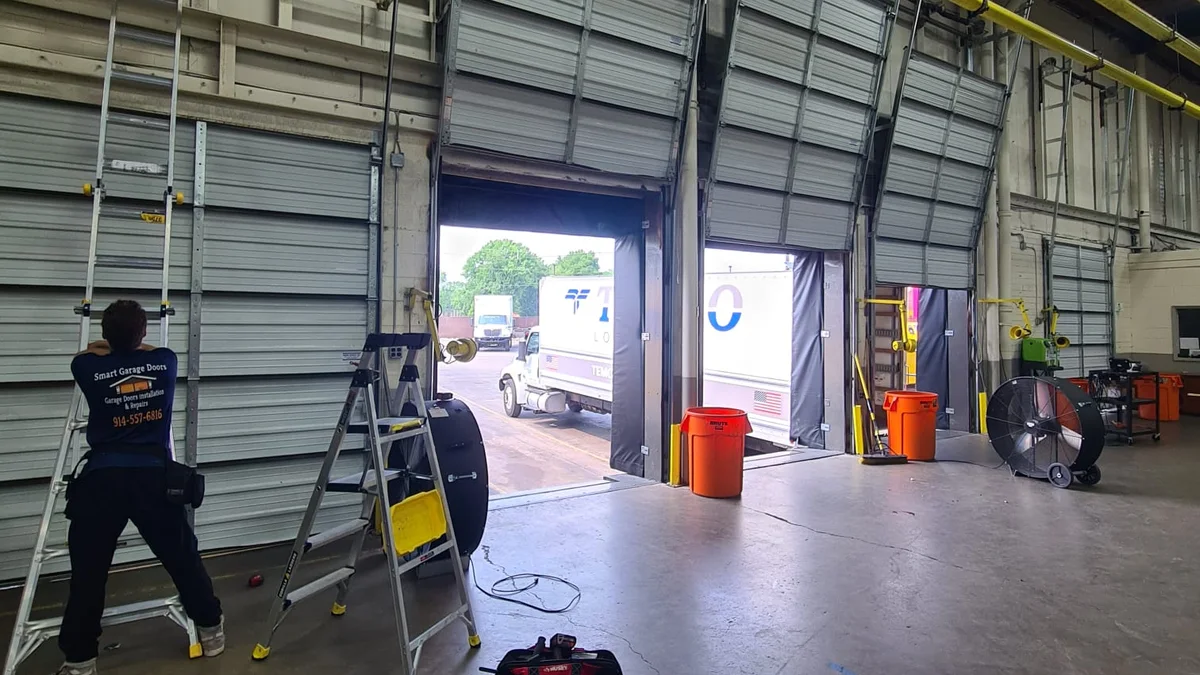
Unplanned bay door downtime stops trucks and revenue. What a quarterly preventive maintenance contract covers, how cycle counts predict failures, and what to demand from a vendor.
Every facilities manager has lived this one: a bay door dies at 7am with a trailer backed up to it, the outbound schedule slips, and somebody upstairs wants to know why a known wear item took the dock down. The door didn't fail suddenly — it failed predictably, after months of telegraphing it through fraying cables and a spring near the end of its cycle life.
Bay doors are one of the few pieces of building equipment that are simultaneously mission-critical and almost universally run to failure. Nobody runs a rooftop unit or a fire pump that way.
This guide covers what a preventive maintenance contract on commercial doors actually includes, how cycle counts predict failure timing, and what separates a real maintenance agreement from a sticker on the door with a phone number.
The Real Cost of an Unplanned Door Failure
When a dock door fails, the repair invoice is the smallest line on the loss. The real costs stack up around it:
- Stopped trucks. A dead bay means trailers wait, detention charges accrue, and outbound commitments slip. If the failed door is one of two or three bays, you've lost a third to half of your throughput until it's fixed.
- Emergency labor pricing. After-hours and emergency dispatch costs more than a scheduled visit, and you have zero negotiating leverage when the dock is down.
- Collateral damage. A snapped cable or failed spring rarely breaks alone. A door that drops or racks in the tracks can bend panels, twist track, and burn out an operator trying to lift an unbalanced load — turning a worn-part replacement into a multi-component repair.
- Safety exposure. A door under spring tension that fails in service is a genuine hazard to anyone near it. That's an incident report, not just a work order.
Preventive maintenance doesn't make doors immortal. It converts most of these unplanned, schedule-wrecking failures into planned part replacements done on your calendar instead of the door's.
Cycle Counts: Why Door Failures Are Predictable
Commercial door components are rated in cycles — one cycle is one full open and close. Torsion springs, the component that does the actual lifting, carry a rated cycle life, and standard springs are commonly rated around 10,000 cycles.
Do the math on a working dock door:
- A door cycling 10 times a day burns roughly 2,500 cycles a year — a standard spring lasts about four years
- A door cycling 25 times a day burns over 6,000 cycles a year — that same spring is done in under two years
- A busy cross-dock bay cycling 40+ times a day can exhaust a standard spring in about a year
Cables, rollers, hinges, and operator drive components wear on similar usage-driven curves. This is why preventive maintenance works on doors: the failure timing isn't random. A technician who knows the door's age, spring rating, and daily cycles can tell you which doors are entering their failure window — and replace the spring on a Tuesday morning you chose, instead of the Friday afternoon it chooses. For more, see our guide to commercial spring cycle ratings.
What a Quarterly Inspection Actually Covers
A real preventive maintenance visit is a systematic pass over every wear point on the door, not a squirt of lubricant and a signature. On a quarterly schedule, each visit should cover:
- Springs — inspection for gaps, rust, and stretch; balance test to confirm the springs (not the operator) are carrying the door's weight
- Cables and drums — fraying, kinks, corrosion, proper seating; cables are cheap to replace and catastrophic to ignore
- Tracks and rollers — alignment, secure mounting, bent sections from impacts, worn or seized rollers
- Operator — drive chain or gear condition, limit and force settings, manual disconnect function
- Safety devices — photo eyes and sensing edges tested, because a door that closes on a person or a forklift is a liability event
- Hardware and panels — hinges, fasteners, struts, and panel condition, with impact damage documented before it spreads
Quarterly is the right rhythm for most working commercial doors. High-cycle bays may justify more frequent visits; a rarely used drive-in door may be fine semi-annually. The cadence should follow the cycle count, not a one-size template.
What a Good Maintenance Contract Includes
The inspection scope is half the contract. The other half is how the vendor operates around it. Before you sign, the agreement should spell out:
- Written documentation per visit. A dated report per door — condition found, work performed, photos, and a flag list of components entering their wear window. This is what lets you budget next quarter's replacements and what protects you in an incident investigation.
- Priority response for breakdowns. Contract customers should go to the front of the line when a door does fail. Ask specifically how breakdown calls from contract accounts are dispatched versus cold calls.
- Consistent, pre-agreed pricing. Labor rates and common wear parts priced in the agreement, so an emergency doesn't come with emergency math.
- One accountable contact. A single person who knows your facility, your doors, and your history — not a call center that treats every ticket as a first encounter.
- A per-door asset record. Door size, manufacturer, spring specs, operator model, and install date on file, so quotes and repairs don't start with a measuring visit every time.
If a vendor can't produce a sample inspection report from another account, that tells you what their "maintenance program" actually is. Our maintenance program and commercial repair service are built around exactly this documentation standard, and property managers running multiple buildings can see how we structure portfolio accounts on our property managers page.
Budgeting: Planned OPEX Beats Emergency Spend
From a budgeting standpoint, a maintenance contract converts door spending from spiky and unpredictable to flat and plannable.
Without a program, door spend arrives as emergency invoices: after-hours rates, expedited parts, plus whatever the downtime cost the operation. None of it is in the budget, and finance asks why facilities didn't see it coming.
With a program, the contract is a fixed line item, and the inspection reports give you a forward view of upcoming replacements — "bay 3's springs are at roughly 80% of rated life; plan replacement next quarter." Wear parts still cost money, but you replace them at scheduled-visit pricing, on a planned date, with the dock running on the other bays while the work happens.
Commercial door work is quoted per door and per site — door sizes, spring configurations, and operators vary too much for flat-rate price lists to be honest. Any vendor worth a contract will put numbers in writing before work begins, and a maintenance agreement locks the rates so they don't drift between visits.
How to Start: Baseline First, Then Schedule
The practical first step isn't signing anything — it's a baseline survey. A technician walks every door at the facility and documents condition, specs, estimated remaining spring life, and anything needing immediate attention. That survey becomes the asset record the maintenance schedule is built on.
From there, doors get grouped by duty — high-cycle dock doors on quarterly visits, low-use doors on semi-annual — and anything already in the failure window gets a planned replacement quote up front, so there are no surprises in month two of the contract.
If you manage doors across multiple facilities, the baseline survey is also where standardizing on one vendor pays off: one report format, one rate structure, one contact, every site. We service commercial accounts across NY, NJ, and CT, and we put scope, schedule, and pricing in writing before the first visit.
Running your bay doors to failure is a budgeting strategy — just a bad one. Smart Garage Doors builds preventive maintenance programs for commercial facilities across NY, NJ, and CT: documented quarterly inspections, per-door asset records, priority breakdown dispatch, and pricing fixed in writing before the first visit. Call for a baseline survey of your doors.
Frequently Asked Questions
Common questions about this topic.
For working dock and bay doors, quarterly is the standard recommendation, and high-cycle doors (20+ cycles per day) may justify more frequent visits. Lightly used doors at low-duty facilities can often run on a semi-annual schedule. The right cadence follows the door's cycle count, not a flat template — a baseline survey establishes which doors need which schedule.
Need Professional Help?
While these tips are helpful, some garage door issues require professional expertise. Smart Garage Doors offers expert repair services throughout NY, NJ & CT.