Roll-Up Gate Repair for Facilities Managers: A Practical Guide
A facilities manager's guide to commercial roll-up gates: the components that fail, what repairs involve, the repair-vs-replace math, and how to stop emergency calls.
If you manage a warehouse, storefront portfolio, self-storage site, or parking structure, roll-up gates are the equipment you think about exactly twice: when they won't open in the morning, and when they won't close at night. Both are business emergencies — one stops revenue, the other stops security. This guide covers how these gates actually fail, what repairs involve, and the point where continuing to patch an old gate becomes the expensive choice.
How a roll-up gate fails: the four usual suspects
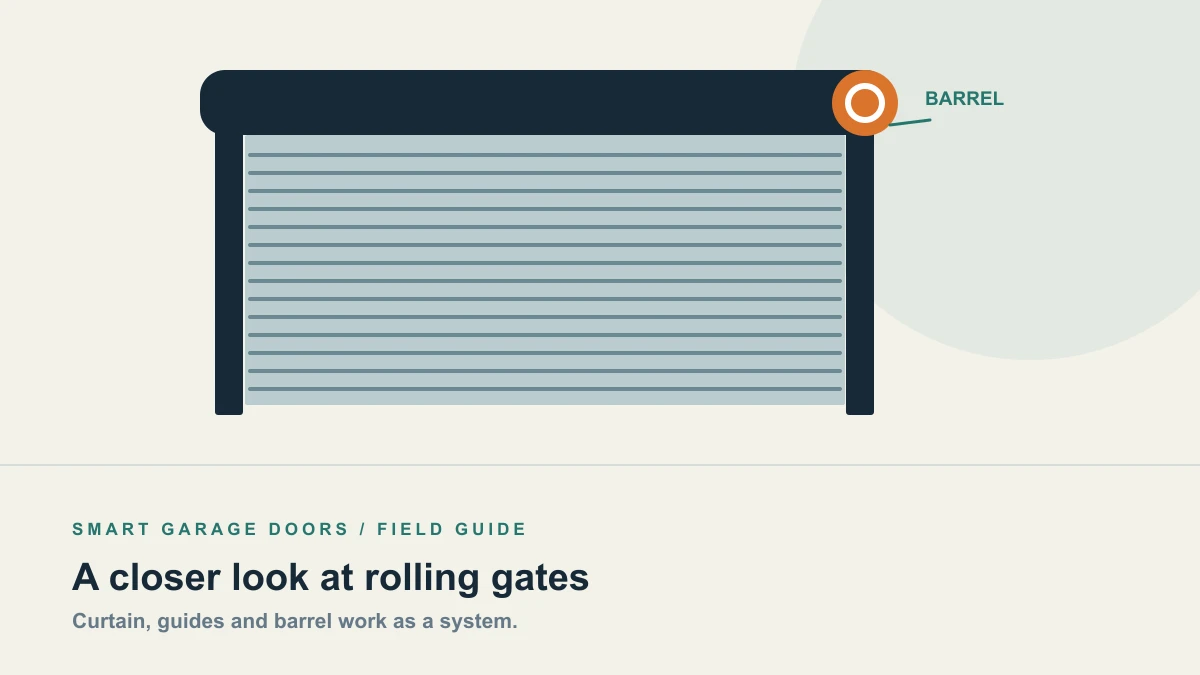
Barrel springs. Inside the coil barrel above the opening, torsion springs counterbalance the curtain's weight. They're rated in cycles, and a gate cycling 20+ times a day exhausts standard springs in a couple of years. Symptoms: the gate gets heavy, the motor strains or trips out, or the gate free-falls the last few feet. Spring failure is the most common terminal event on neglected gates.
Slats and guides. Individual steel slats take forklift bumps, cart strikes, and break-in attempts. A few bent slats bind in the side guides, the motor fights the friction, and the wear cascades. Slats are replaceable individually — catching three bent slats early is dramatically cheaper than replacing a curtain that's been ground into its guides for a year.
The operator (motor). Commercial gate operators fail from heat, worn drive chains, stripped gears, and limit switches that drift out of adjustment. If the motor runs but the gate doesn't move — or it stops at the wrong heights — that's operator territory, and often repairable without replacing the whole unit.
Manual release and chain hoist. The components nobody tests until the power is out. If the manual chain is seized, a power outage turns into a locked building. Ask when this was last operated at your site; the honest answer is usually 'never.'
The downtime math every FM already knows
The repair invoice is rarely the real cost. A gate that won't open is trucks queued at a dock, staff standing idle, or a storefront that can't trade. A gate that won't close is either an overnight security guard bill or an unsecured building — and for some tenants, a lease-compliance problem by morning.
That asymmetry is why commercial gate service is structured around response, not just repair: our commercial calls get priority dispatch on a 24/7 line with an exact ETA when you call, and technicians carry high-cycle springs, common slat profiles, and operator parts on the truck so most failures are resolved in one visit. It's also why the gates that matter most shouldn't be run to failure at all — more on that below.
Repair or replace? A simple framework
Patch-versus-replace is a judgment call, but these rules of thumb serve facilities teams well:
- Repair when the failure is isolated (springs, a handful of slats, operator components) and the curtain and guides are otherwise straight. A gate with a healthy curtain justifies new springs and even a new operator.
- Lean replace when the curtain itself is badly corroded or racked, when repairs are recurring quarterly, or when the gate long predates the duty it now runs — a gate installed for 5 cycles a day now doing 40 will never stop breaking, because every component is undersized for the job.
- Always replace like-for-duty, not like-for-like. The single most valuable spec decision is matching springs and operator to the gate's *actual* daily cycles. High-cycle springs cost more once and fail years later.
An honest vendor should show you the math on both paths — repair cost against remaining life — and put it in writing. If every recommendation is 'replace,' get a second opinion.
How to stop having gate emergencies
Roll-up gates fail predictably: springs by cycle count, slats by traffic, operators by heat and wear. Predictable failure is schedulable failure. A preventive maintenance program — quarterly inspection of springs, guides, slats, operator, and the manual release, with a written per-gate condition report — converts most 6am emergency calls into planned line items, and priority breakdown response covers the failures that still slip through.
For multi-site portfolios, the bigger win is consolidation: one vendor with per-gate records at every property, one rate structure, one COI to manage. Every additional door vendor is administrative overhead, and none of them knows your equipment history.
The practical first step costs nothing: a baseline survey, where a technician walks every gate and door at your facility and documents condition, spring life, and immediate risks. You keep the report either way — facilities teams use it for capital budgeting even when they never place a service call.
Gate down, or tired of patching the same one? Call (914) 557-6816 for priority commercial dispatch, or start with a free baseline survey of every gate and door at your facility — you keep the written report either way. See our rolling steel gate repair service and commercial maintenance contracts.
Frequently Asked Questions
Common questions about this topic.
Almost always the barrel springs — they've lost tension or broken, so the counterbalance is gone and you (or the motor) are lifting the curtain's real weight. Stop forcing it: running a gate on dead springs burns out operators and stretches the curtain. Spring replacement restores the balance.
Need Professional Help?
While these tips are helpful, some garage door issues require professional expertise. Smart Garage Doors offers expert repair services throughout NY, NJ & CT.